
You’ve had the conversation.
You’ve clarified what needs to happen. Maybe you’ve introduced a new process, sent someone on training or agreed new targets.
For a while, things improve. Then three weeks later, you’re having the same conversation again.
Eventually, you step back in. You check the work. You chase the numbers. You make the decision. You speak to the customer. You solve the problem. And slowly, without necessarily intending to, you become the bottleneck again.
The obvious conclusion is that your team needs more accountability, better processes or more training. Sometimes they do.
But if you keep fixing the same performance problems and they keep coming back, you may be trying to change things at the wrong level.
I am an ActionCOACH business coach based in Horsham, and this is one of the most common patterns I see with owners across West Sussex, Surrey and the Gatwick Diamond.
What you see isn’t necessarily the problem
Think about an iceberg. Above the waterline is everything you can easily observe: actions, behaviours and decisions.
These are visible, so naturally this is where leaders tend to intervene. We introduce another process. We set another KPI. We have another conversation. We provide more training.
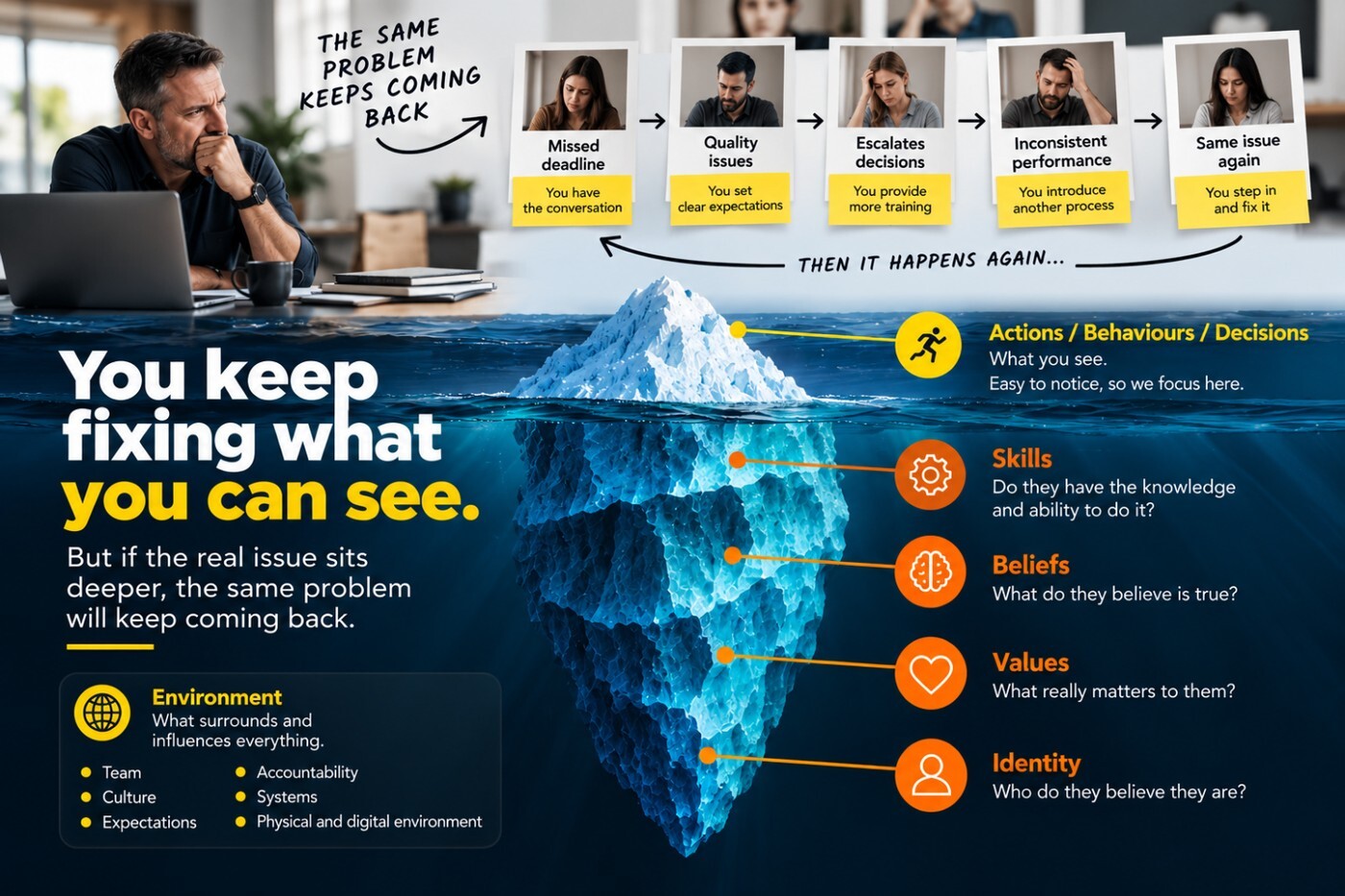
But underneath those visible behaviours sit four increasingly deeper layers: Skills → Beliefs → Values → Identity. And surrounding all of them is the environment in which that person operates.
If you want sustainable performance from your team, you need to understand which layer you’re actually trying to change.
Skills: Can they actually do it?
Start here. Does the person genuinely have the skills required to deliver the outcome?
This sounds obvious, but businesses regularly promote technically capable people into management and then wonder why they struggle to lead. Being brilliant at the job doesn’t automatically make someone brilliant at leading other people doing the job.
Equally, telling somebody what outcome you expect doesn’t mean they know how to produce it. If the gap is skill, develop the skill.
But don’t assume every performance problem is a training problem. Somebody can know exactly how to do something and still consistently fail to do it. Then you need to go deeper.
Beliefs: What do they believe about it?
Imagine a manager who knows exactly how to challenge poor performance. You’ve trained them. You’ve given them the framework. Yet every time somebody misses an agreed outcome, they avoid the conversation.
Why? Perhaps underneath the behaviour sits a belief:
Now you can see the problem. More training won’t necessarily fix it. They already know what to do. Their belief is overriding their skill.
And when that happens repeatedly across a management team, guess where the unresolved problems eventually arrive? At your desk.
Values: What matters enough to influence the decision?
Go deeper again and you reach values.
Someone might value harmony very highly. That can be a strength. But when harmony matters more than accountability, difficult conversations get avoided.
Someone might value independence. Again, potentially valuable. But if independence becomes resistance to collaboration or agreed systems, performance suffers.
This isn’t about deciding whether someone’s values are good or bad. It’s about recognising that values influence decisions, particularly when there is pressure.
Your business may have beautifully written values on the wall. The more important question is: what values are actually driving behaviour when nobody is watching?
Identity: Who do they believe they are?
This is the deepest level of the iceberg. Consider the difference between somebody who thinks “I’ve been promoted to team leader” and somebody who believes “I am responsible for the performance of this team.”
Same job title. Potentially very different behaviour.
One may still see themselves primarily as the best technician in the team. So when things go wrong, they jump in and do the work. The other understands that their job has changed. Their success is no longer measured primarily by what they produce. It’s measured by what the team produces.
That identity shift is fundamental to building a high-performing management team. And business owners face exactly the same challenge.
If you still fundamentally see yourself as the person who solves the important problems, don’t be surprised when everybody keeps bringing the important problems to you.
Environment: What does your business reinforce?
Then there is the water surrounding the iceberg. This is where leaders need to be prepared to look in the mirror, because sometimes the team isn’t the only problem.
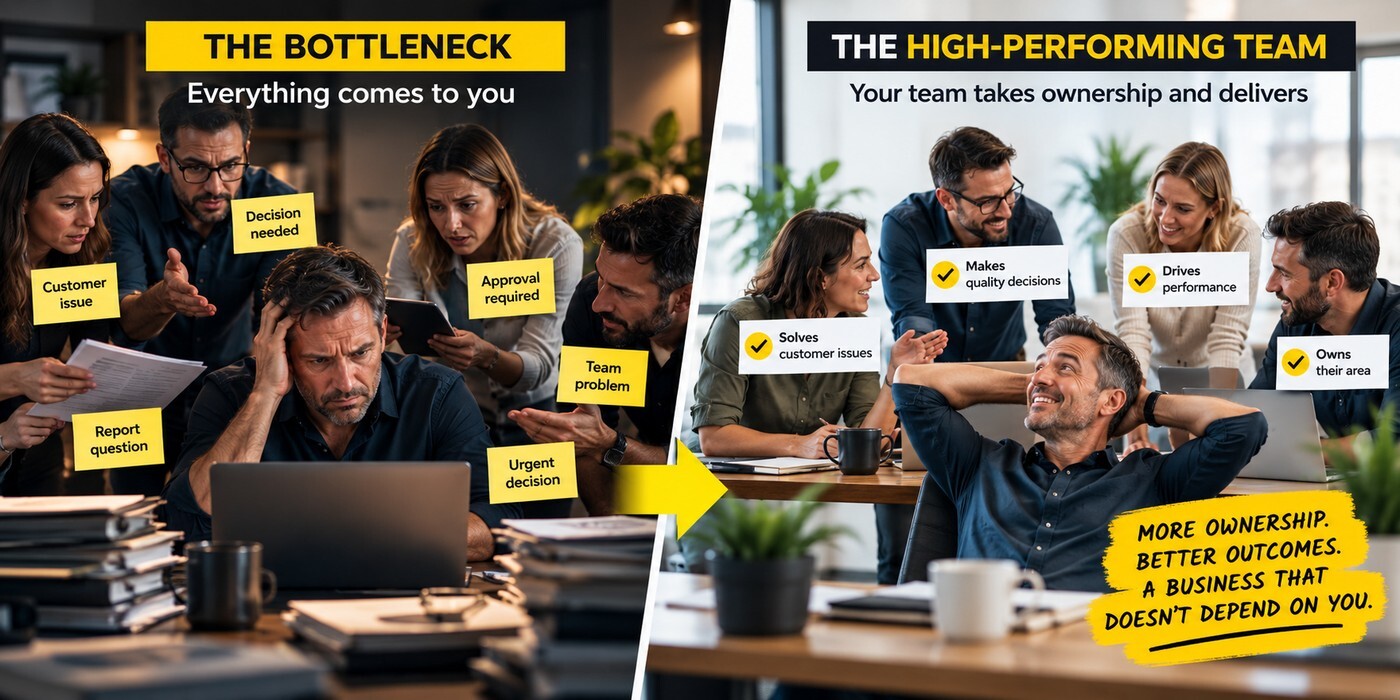
You say you don’t want everything depending on you. But the environment you’ve created may be teaching everyone: when it really matters, take it to the owner.
That is how a bottleneck gets built. Not always because the owner wants control. Often because they’re capable, care deeply about the business and can solve the problem faster than anyone else.
But every time you solve a problem your team should be learning to solve, you may be strengthening the very dependency you’re trying to remove.
Stop fixing every problem at the surface
So when somebody isn’t delivering, resist the temptation to immediately ask “How do I get them to do this?” Diagnose first.
Because the solution needs to match the level of the problem. You cannot train your way out of a belief problem. You cannot process your way out of an identity problem. And you cannot demand ownership while creating an environment that teaches people to depend on you.
High-performing teams don’t happen by accident
The goal isn’t simply to get your team to do more. It’s to build a team capable of producing increasingly better outcomes without everything having to pass through you first.
That requires clear expectations. It requires accountability. It requires good systems. But it also requires understanding what drives human performance beneath the surface.
So the next time you find yourself thinking “Why am I having to deal with this again?” don’t immediately jump in and fix it. Look beneath the waterline.
Because if the same problem keeps finding its way back to you, the problem may be deeper than the behaviour you can see. And until you solve it at the right level, you’ll keep being the solution your business depends on.
Stop guessing where the bottleneck is. If you run a business in Horsham, Crawley or the wider Gatwick Diamond, find it by completing the 6 Steps to Business Freedom Assessment, and then get in touch to book a twenty minute discovery call.
