
I find myself asking business owners a version of the same question quite regularly.
What is your job now?
It sounds obvious, but it's surprisingly difficult to answer.
I might be talking to someone running a £1m, £2m or £5m business. They've got a decent-sized team, established clients and perhaps several managers reporting into them.
But when we look at where their time actually goes, they're still doing quite a lot of the same things they were doing when the business was a fraction of the size.
They're still getting involved in delivery.
They're still sorting out operational problems.
They're still making decisions that somebody else should probably be making.
The business has grown. Their role hasn't necessarily grown with it.
It's something I've been thinking about for a while, and it's why I've started using what I call the Freedom Ladder with clients.
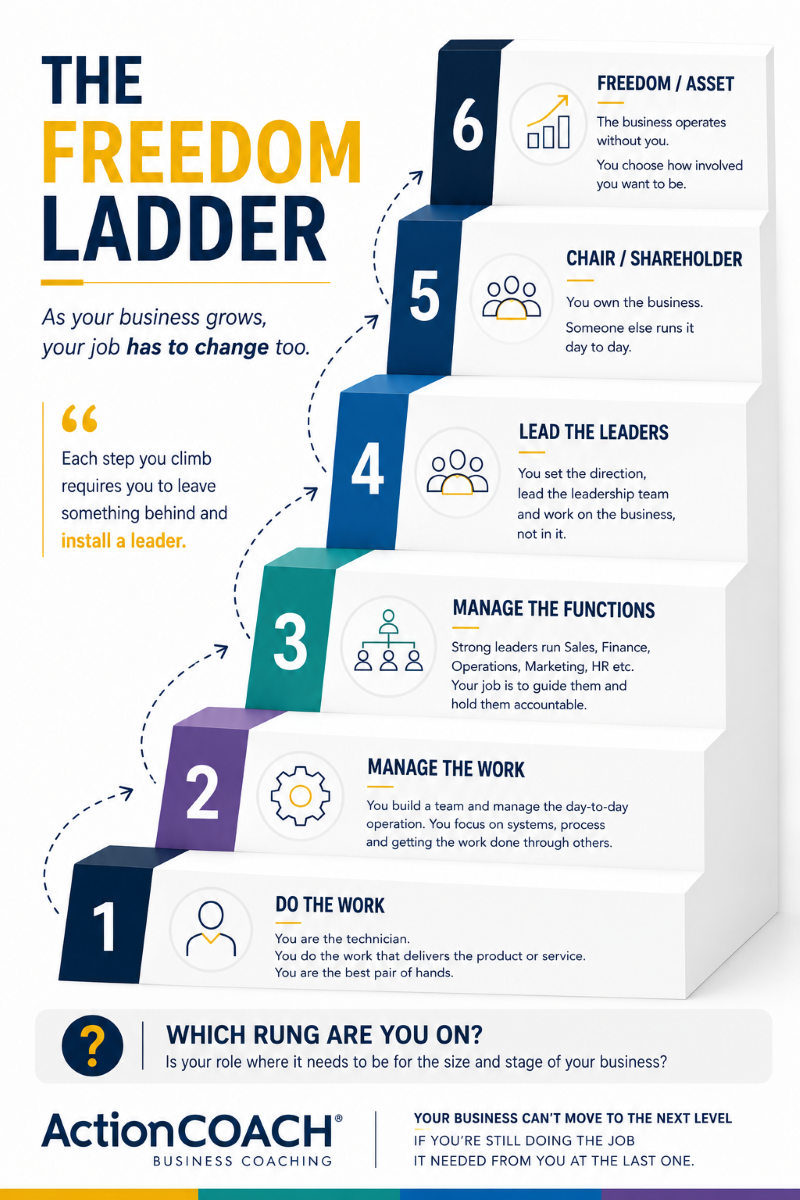
The basic idea is that there are a series of stages we go through as business owners.
At the bottom, you're doing the work. You're probably the best pair of hands in the business, which is often exactly how you got started.
Then you begin building a team and your job changes. You need to step away from doing and start managing the day-to-day operation.
As the business grows again, that needs to change too. You put people in charge of the different functions – sales, finance, operations, marketing – and your job becomes managing those people rather than doing their jobs for them.
Eventually, you're leading a leadership team.
Beyond that, you might have an MD or CEO running the business while you move into a Chair or shareholder role.
And ultimately, you have something that can genuinely operate without you – whether you choose to sell it, retain it, scale it further or go and do something else.
That's the ladder.
The interesting bit isn't understanding the stages, though.
It's working out which one you're actually on.
Because your job title doesn't necessarily tell you.
You can call yourself Managing Director and still spend half your week doing operational work.
You can have a Head of Sales and still be making most of the important sales decisions yourself.
You can employ 30 people and still have customers who insist on dealing with you personally.
Quite often there's a gap between where the business has got to and where the owner has got to.
One of the questions I use to expose that gap is:
"Is this the best use of my time, at my value per hour?"
If the answer is no, something needs to change.
That doesn't mean simply throwing the work at somebody else.
I've seen plenty of delegation fail because the owner hasn't done the work beforehand.
The approach I use is Design → Systemise → Train → Delegate.
First, be clear about the role and the outcome you need.
Then work out and document how it should happen.
Build somebody else's capability to do it.
Only then can you properly hand over responsibility and hold them accountable for the result.
And this doesn't only apply to the owner.
As you climb the ladder, the people underneath you need to start climbing their own version of it.
Your Operations Manager develops people underneath them.
Your Sales Director does the same.
Your Finance Director does the same.
That's how the business starts becoming less dependent on individuals and more capable as an organisation.
There's another point here which I think is important.
You can't skip a rung.
I've seen owners try to become more strategic when there isn't anyone capable of running operations. Or step away from a function when nobody really owns it.
It rarely lasts.
Something goes wrong and they're dragged straight back down again.
The level below has to be working before you can properly leave it behind.
So perhaps the useful question isn't, "How do I get out of my business?"
It's:
"What do I need to build underneath me so I can move up?"
Have a look at your diary from the last couple of weeks.
How much of what you've been doing genuinely requires you?
How much could be owned by somebody else if the role, systems and training were in place?
And what aren't you doing because your time is still being consumed by the level below?
I've found those questions can create some quite uncomfortable answers.
But they also give you somewhere practical to start.
Because the goal isn't to do less for the sake of it.
It's to keep changing your job as the business changes.
And perhaps that's one of the things we don't talk about enough when we talk about scaling.
Your business can't really move to the next level if you're still doing the job it needed from you at the last one.
