
Business owners often tell me their problems are unique to them. In the detail, they might be, but I see the same problems in most businesses.
The table shows the top ten topics that my regular clients are discussing with me. It’s not guesswork, this is the reality. The “Share” column shows what percentage of clients discuss this issue. It’s amazing how frequently the same issues occur across a range of businesses from different industries.
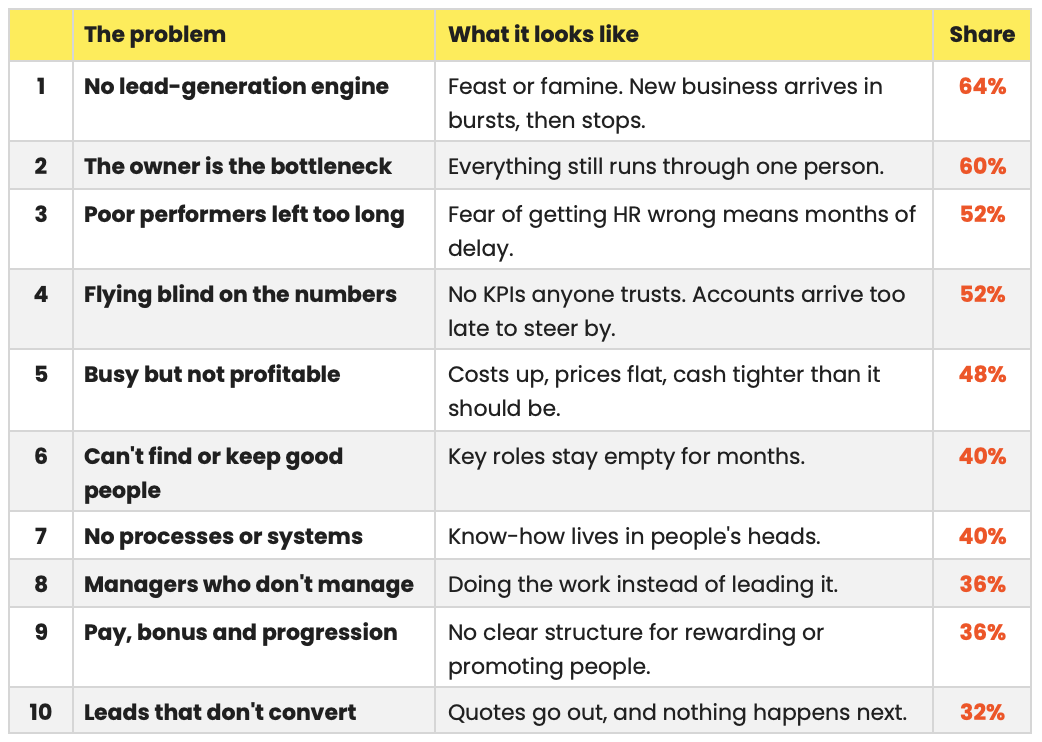
Just outside the top ten: co-owners pulling in different directions, a vision with no plan to get there, too much depending on one key person, reliance on one big client, and a need for clarity about using AI.
These aren't start-up problems
These are established businesses, turning over seven figures and beyond. Many have a management team, a marketing manager, a finance function and an HR adviser. Good people don't make these problems go away. Sometimes they just hide them for longer.
Three root causes
Squint at the list and the ten collapse into three.
- The owner and the team. Struggling to let go, and putting off the difficult conversation. That's the bottleneck, the poor performers, the people problems and the managers who don't manage.
- The engine. Few repeatable processes across the business, and no systems to ensure the processes operate when and how they should.
- The dashboard. Not being able to see what's really happening until it's already happened. That's the numbers, the profit that doesn't match the effort, and the missing systems.
Same problem, different cause
When a manager asks me how they should manage their team, I tell them there's only one answer that works: differently for each one. Businesses are no different. The table shows common threads. It doesn't show common causes, and two businesses can have exactly the same problem for completely different reasons.
Take the top one – “No lead-generation engine”. In one business, nobody has clear responsibility for bringing in new customers. In another, the team work hard at generating leads, but they’re mostly the wrong kind of leads. And in a third, they’re strong on strategy, but there’s not enough of the right resource to implement the work consistently. Same problem, different causes.
Borrow someone else's fix and there's a good chance you'll fix the wrong thing. Diagnosis comes before prescription, in business as much as anywhere.
Take Action!
Read the table again and pick the topic that resonated with you most. Then, before you do anything about it, write down in one sentence why it's happening in your business. Not in businesses generally. In yours.
If you can't write that sentence, you've found where to start. Then be decisive – what will you do to start solving that issue today?
