
Why growing businesses end up with more deputies than managers, and how to fix it.
Over the years, I've worked with plenty of businesses that have grown past the 50-person mark, and I keep noticing the same strange pattern. Suddenly, from nowhere, assistants and deputies start to appear, sometimes more of them than actual managers.
It's easy to shrug this off as normal. Even schools have deputy heads and classroom assistants. But in my experience, it's often one of the earliest signs that a business has started to lose its way: it becomes slower to respond, more bureaucratic, and a less enjoyable place to work.
How it starts
Picture a smaller business in a high-growth phase. Like most organisations, it runs on a hierarchy: one manager overseeing the people doing the work. But because the business is still small, that manager wears several hats at once; a sales manager might also be handling marketing, customer service and admin. It takes real skill to juggle all of that well.
As the business grows, the workload grows with it, until the manager is too stretched to cope. So, they ask their boss for help. The owner thinks, reasonably enough: “This person is valuable, let's get them some support,” and hires an assistant.
Relief all round, at first. The manager hands off the low-skill, low-enjoyment tasks they never liked doing, and for a while it works.
Where it goes wrong
The business keeps growing. Now it's the assistant who's overloaded, so another assistant joins, and the least interesting jobs keep getting passed down the chain. Before long, there are more assistants than managers.
The keen assistant who joined hoping to grow starts to wonder why they're stuck doing the tasks nobody else wants. Motivation dips. Meanwhile, the manager, now free of the work they disliked, may start to coast. When performance slips and the owner asks why, the manager points at the assistant.
The assistant, already demotivated, either leaves or stays and vents to the rest of the team, who start to feel the same unfairness, and performance drops further still. The owner is left wondering why an operation that used to run lean is now twice the size and half as efficient.
The fix: roles, not people
It would be unfair to blame either the manager or the assistant. The real problem started the moment the owner thought: “Let's get another person just like the manager.”
What gets missed is that every organisation, large or small, is built from a set of clearly defined roles, from office cleaner right up to Managing Director. In a small business, one person carries several roles at once, but the roles themselves still exist independently of who's doing them. Even a five-person company has a Finance Director role; it's just part-time, and the skill level required is lower than it would be at a large corporate. The role is still there.
So instead of “let's clone the manager,” the better question is: “Which of these roles is the manager actually good at, and who else should we bring in to take on the rest?”
Take a founder who's been running sales, marketing, and customer service single-handedly as the business scales. A role audit might show their real strength is relationship-led sales, not the analytical, campaign-driven side of marketing. The fix isn't a generic assistant; it's splitting out the marketing role and hiring someone whose strengths actually match it, whether that's an in-house hire or a specialist working alongside a remote or hybrid team.
This is where a simple framework like RACI, who's Responsible, Accountable, Consulted, and Informed for each role- earns its keep. It forces you to look at roles and responsibilities on their own terms, separate from whoever currently happens to be doing them.
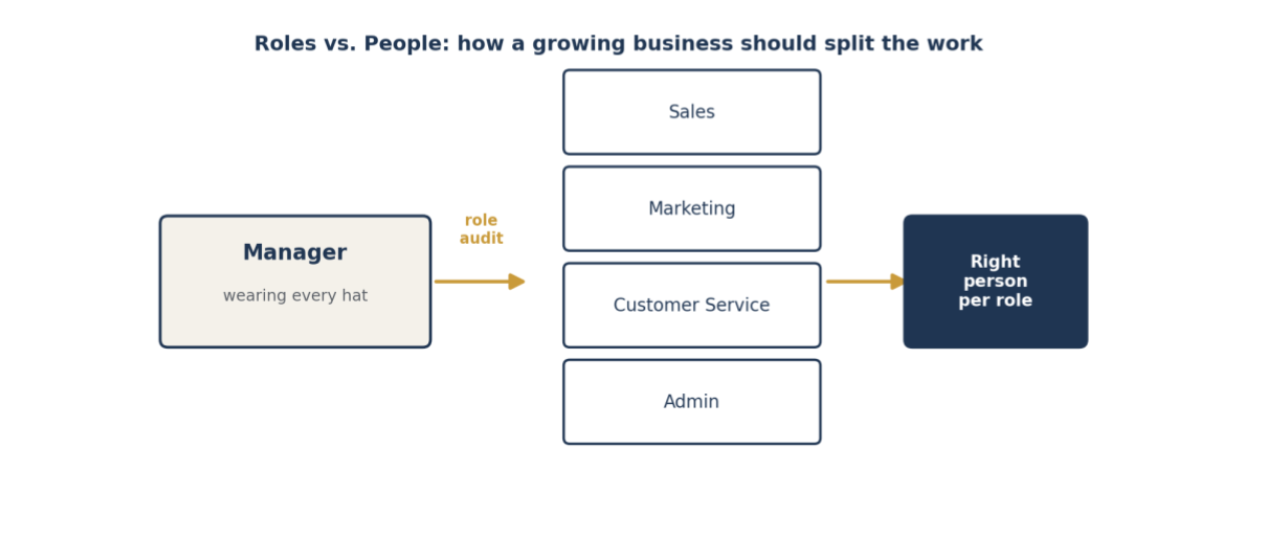
Continually reviewing who holds which roles, and splitting and reallocating them as the business grows, is one of the most important habits for keeping an organisation efficient. It keeps lines of responsibility clear, makes accountability easier, and keeps the business lean.
Three signs your business has too many deputies
• Job titles keep multiplying, but nobody can say exactly what each new role is accountable for.
• The most experienced people spend their time on the least valuable tasks, because that's what's been “passed down.”
• Performance issues get blamed on individuals rather than traced back to unclear role design.
So, take a look at your organisation chart. Are you looking at roles, or just people you've hired to cope? Reallocate the roles properly, and you may find you need far fewer deputies than you think.
Want a second pair of eyes on your organisation chart?
I offer a free, no-obligation initial chat to business owners who want to talk through role clarity, delegation, or scaling challenges. If any of this sounds familiar, let's have a conversation- no pitch, just a look at what's really going on in your business.
Get in touch – kevinstansfield@actioncoach.com
