
Business owners don’t generally start a business because they want to become tied to it seven days a week. They may want greater financial freedom or the opportunity to build something valuable they can eventually sell. They also want more control over their time.
Yet as the business grows, many owners find themselves with exactly the opposite. They’re still doing the work and making most of the decisions.
Bill sees this regularly with business owners who have grown their company but haven’t yet changed their own role within it. The Ladder of Freedom shows the stages an owner needs to move through to build a business that can operate without depending on them every day.
At the top, the owner has a choice. They can remain involved at a strategic level or eventually release the asset.
Start building a business that can run without you
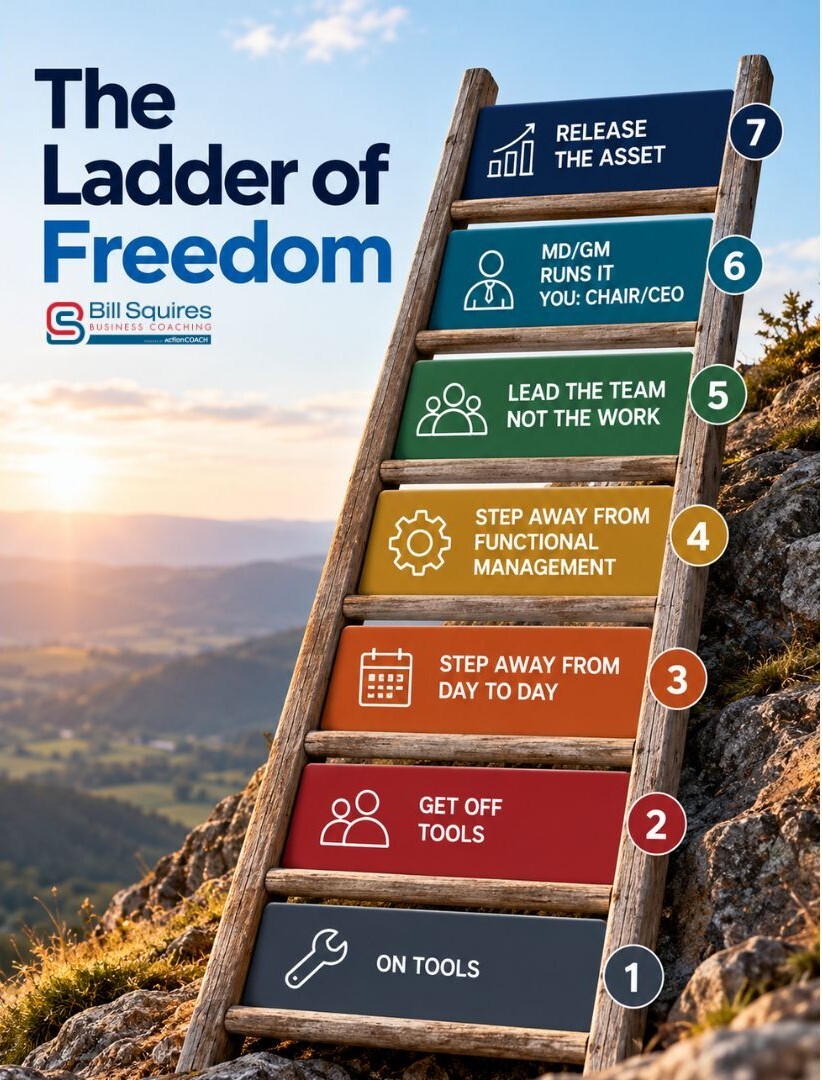
What is the Ladder of Freedom?
The Ladder of Freedom is a simple way to show how a business owner’s role needs to change as the business grows. Each step moves the business further away from relying on the owner day to day and closer to giving them more choice over how involved they want to be.
Step 1 – You’re on the tools
Most businesses begin here. The owner is doing whatever the business sells. An electrician is doing electrical work. An agency owner may be delivering client work. In a professional services business, the owner is likely to be providing much of the service themselves.
There’s nothing wrong with this in the early stages. Someone has to do the work. The problem comes when the business grows but the owner’s role doesn’t change.
There are only so many hours available. If revenue still depends heavily on how much work the owner can personally deliver, there’s a natural limit on how far the business can grow.
The next step is to start changing that.
Step 2 – Get off the tools
Getting off the tools means having other people deliver more of the work, which is often harder than it sounds. Some owners worry nobody will do the job as well as they do. Others struggle to find the right people or find it difficult to hand over responsibility once they do.
But if the owner remains central to delivering the service, the business will continue to depend heavily on them. This has to happen gradually. Find the right people and give them the support they need to develop into the role.
Getting off the tools isn’t about disappearing overnight. It’s about steadily reducing how much of the delivery relies on the owner.
Step 3 – Step away from the day-to-day
Getting off the tools doesn’t automatically create freedom. An owner can stop doing client work and still spend every day solving problems or checking what everyone is doing. Important decisions may still depend on them too.
At this stage, responsibility needs to start moving further into the business. Think about the main areas of the company:
- Who takes responsibility for operations?
- Who owns the other key functions?
If the answer is still the owner in almost every case, they haven’t really stepped away.
The appointment of an operations manager is an important move for growing businesses because operations can take up such a large part of the owner’s time. But it’s still only one area of the business.
Step 4 – Step away from functional management
This is where the structure of the business starts to become stronger.
Instead of having people simply carrying out tasks, there are people taking responsibility for different parts of the company. The owner is no longer acting as the default manager for everything.
There is an important distinction here though - delegation isn’t abdication.
Some business owners appoint someone to a role and then step away too quickly. They expect the new person to understand the business in exactly the same way they do. They won’t, at least not immediately.
The owner still needs to coach them and stay close enough to check progress. People need time to understand what’s expected of them and develop confidence in the role.
Step 5 – Lead the team, not the work
Once capable people are taking responsibility for the different functions, the owner’s role changes again as they move from management towards leadership.
Instead of being involved in how every job gets done, the focus shifts towards the people responsible for delivering the results.
This stage is simply focusing on leading the team. It means helping people perform well and making sure responsibility sits in the right place.
The business becomes less dependent on the owner’s ability to solve every problem.
Step 6 – Let an MD or GM run the business
Eventually, the business may reach the stage where it has the people and structure for someone else to take responsibility for running it - a Managing Director or General Manager. The owner can then move towards a Chair or CEO role.
They’re still involved, but at a more strategic level. Their attention can move away from what happened in operations this morning and towards where the business is heading.
For some owners, this is exactly where they want to be. They can remain connected to a business they’ve built without having their life dictated by its daily demands.
Step 7 – Release the asset
The final step is optional.
An owner might decide to sell the business or release some of the value they’ve created. What matters is that they have the choice. A company that depends completely on its owner is difficult to step away from. It may also be less attractive to somebody looking to buy it.
If every important client relationship sits with the owner and the team relies on them for decisions, the business is still heavily tied to one person. Moving up the Ladder of Freedom is about gradually changing that.
Even if a sale never happens, the owner has built a business that gives them more options.
Learn more about Bill and the team
Where are you on the Ladder of Freedom?
There’s nothing wrong with being near the bottom of the ladder. Every business starts somewhere. The problem is staying on the same step for years while expecting the business to provide more freedom.
Each move up the ladder can be difficult. Finding the right people takes time. So does learning to hand over responsibility well, but it’s important to keep moving.
An owner might still be on the tools or may have stepped away from delivery while remaining responsible for most of the business. Further up the ladder, the management team may already be strong enough for them to step back again.
Wherever they are, there’s one useful question to ask - what needs to change to move up one step?
Building a business that can run without its owner doesn’t happen overnight. But each step can reduce the business’s dependence on one person and move the owner closer to having genuine choice over what comes next.